

Young Union Leaders in India Train on Fair Recruitment and Labor Migration
Posted
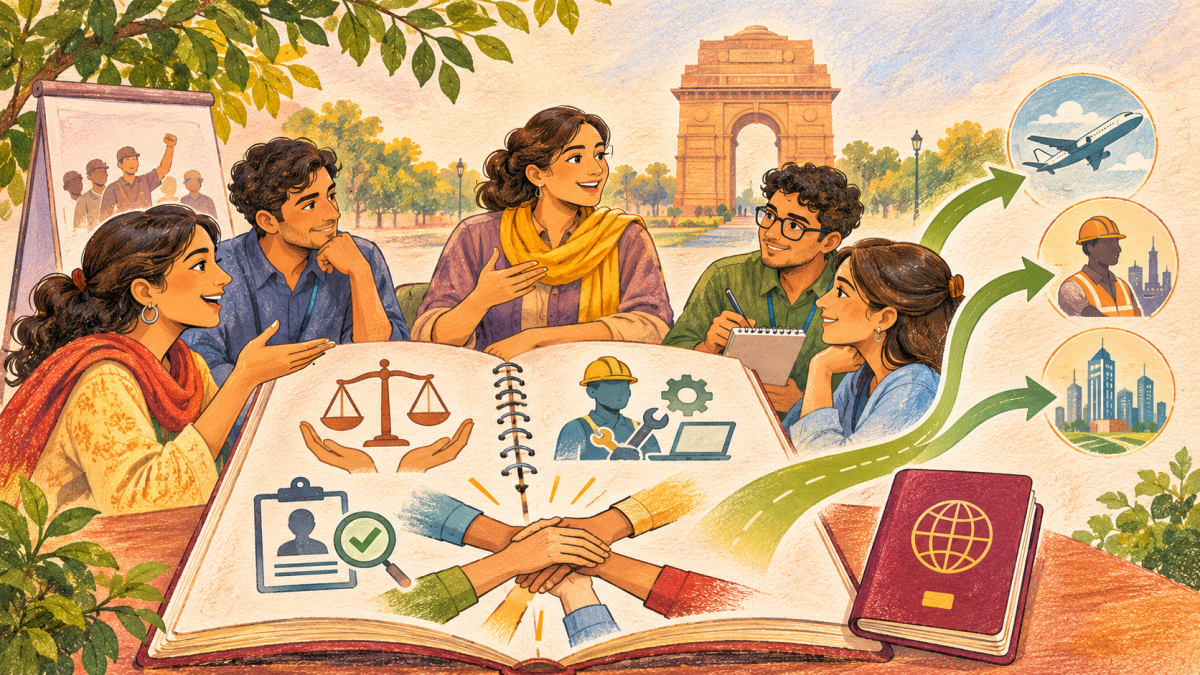
Young trade union leaders in India examined fair recruitment and skills-based labor migration during a two-day workshop in New Delhi on Nov. 17–18, the International Labour Organization reported Nov. 20. The training focused on how unions can support migrant workers through recruitment and the wider migration process.
The workshop was organized through the ILO's Promoting Safe Employment Pathways and Fair Recruitment Practices project, supported by Immigration, Refugees and Citizenship Canada. The organizer's account describes capacity building and planning, rather than a new employment law, a recruitment service or a program placing participants in jobs.
Participants arrived with different levels of familiarity with fair-recruitment principles and international standards, according to the ILO. The workshop introduced those concepts and used practical exercises to connect them with the responsibilities of unions and other organizations involved in migration.
Looking beyond the recruitment stage
Group exercises asked participants to map the different actors in the labor-migration cycle. Case studies examined situations that could involve unfair recruitment or violations of workers' rights. The aim was to identify where unions could intervene and how responsibilities change at different stages.
That approach extends the discussion beyond the moment a worker accepts an offer. The ILO says participants considered the wider migration process, including the roles of different stakeholders and opportunities for social dialogue. The report does not describe a single procedure that applies to every worker, country or recruitment arrangement.
The event also drew on international perspectives. Contributors included a special adviser to the General Federation of Jordanian Trade Unions, a representative of the International Domestic Workers Federation and a migration-resource-center coordinator associated with SBMI Indonesia.
Their contributions gave participants examples of how unions and worker-led organizations organize and advocate in other settings. The ILO frames those experiences as possible sources of learning for India, not as evidence that a policy from one country has already been adopted in another.
Planning with existing organizations
The workshop concluded with collective action planning. The organizer says participants sought practical entry points for union engagement, building on existing capabilities instead of creating parallel structures.
Areas identified for future collaboration included state-level organizing and awareness activities, capacity building on digital platforms and social media, and stronger engagement with regulatory and international bodies. These are proposed directions for further work. The report does not provide implementation results, a funded timetable for each activity or a count of workers already reached.
The broader project is listed by the ILO as running from March 24, 2024, through May 31, 2028. That project period supplies context for the November workshop but does not mean the training itself lasted four years or that every planned activity has been completed.
The immediate outcome confirmed by the organizer is a completed two-day learning and planning event. Its longer-term relevance will depend on how participants and their organizations translate those discussions into recruitment practices, support and representation for migrant workers. The Nov. 20 report supplies an account of that training, with future collaboration kept separate from measured results.